Consistency doesn’t have to mean doing more
Most consistency advice sounds the same: build a content calendar, batch everything, post on schedule, stay disciplined.
It’s solid advice on paper.
But it just doesn’t hold up against an actual week, the one where your energy tanks on a random afternoon, a client emails at 4 pm with an “urgent” request, and your kid comes home sick from school.
We were never designed to be constantly on the go.
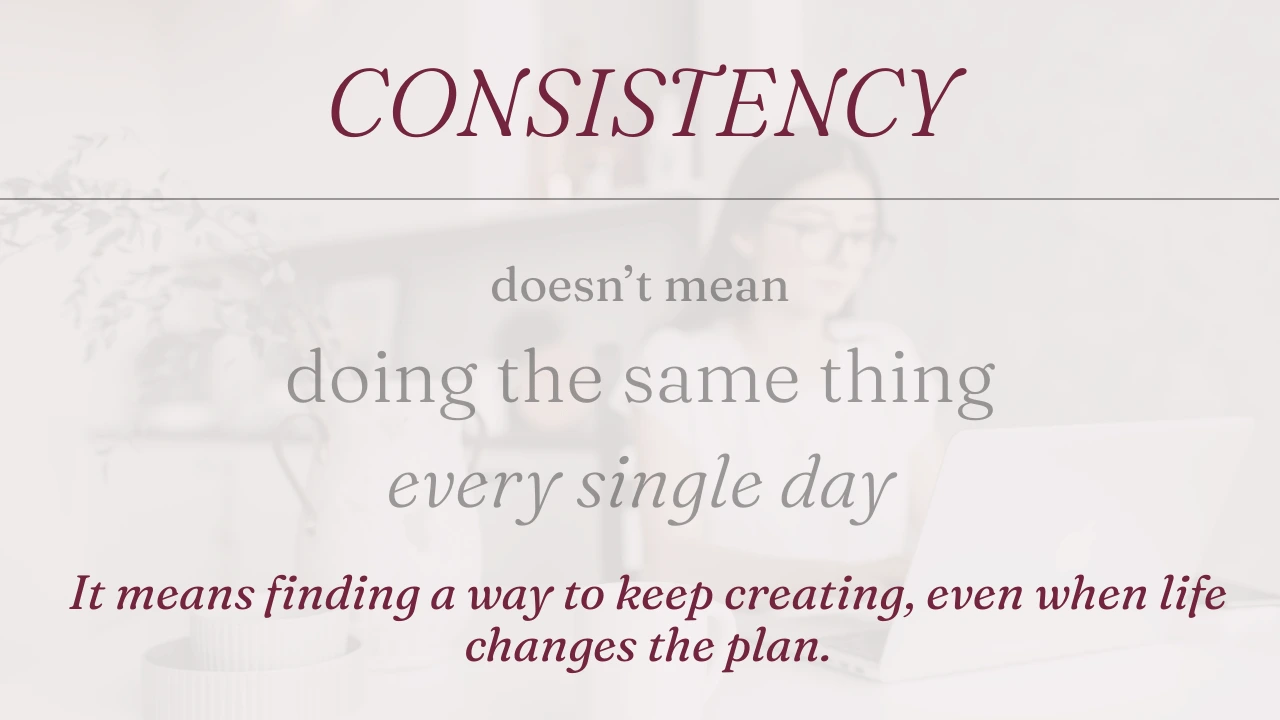
Consistency isn’t really about sticking to one rigid routine. It’s about making the act of creating easy enough to repeat, even when your schedule, energy, and plans keep shifting under you.
That’s where tiny habits come in, and these are small behaviors that cut down on decisions, friction, and how much you have to rely on motivation just to show up.
You don’t need a complicated system to get more consistent. You need a handful of habits that make creating easier to start, easier to keep going, and easier to come back to when you inevitably fall off.
1. Keep an idea capture habit
You sit down to create, and the first thing that hits you is: what am I even going to make today?
That blank-page moment is avoidable. Keep one simple place, a notes app, a notebook, whatever you’ll actually use, and capture ideas the moment they show up.
They can come from:
- questions people keep asking you
- comments or conversations that stick with you
- something you’re learning right now
- a problem you’re personally dealing with
- other creators’ content
- random observations from your everyday life
The key shift here is separating two jobs that don’t belong together, like coming up with an idea and creating the content.
When you’ve got a running bank of ideas, you’re choosing what to make instead of scrambling to invent something from nothing.
2. Decide tomorrow’s most important creative task tonight
Before you close your laptop for the day, ask yourself one question: what’s the one creative task that would make tomorrow feel like a win?
Maybe that’s:
- writing the introduction to your next post
- recording one video
- designing three Pinterest graphics
- finishing a first draft
- editing yesterday’s footage
You can name two or three priorities if you want, but resist turning this into a sprawling to-do list.
The point isn’t to plan out your whole day, but to remove the first decision you’d otherwise have to make in the morning, when your willpower is already at its highest and easiest to waste on deciding instead of doing.
3. Give your creative work a recurring appointment
Put a creative block on your calendar and treat it like it belongs there. That could look like:
- Tuesday morning for writing
- Thursday afternoon for filming
- Saturday for Pinterest
- 30 minutes after breakfast for your newsletter
The specific slot matters less than the fact that it exists. And here’s the nuance that keeps this from backfiring: don’t treat the schedule as sacred.
If Tuesday at 9 am falls apart, that’s not proof you’ve failed. The actual goal is “I regularly make time for this,” not “if I miss my slot once, the whole system’s broken.”
What to Do When You Only Have 5 Hours a Week for Your Business
4. Make your creative tools ridiculously easy to reach
This one’s less about mindset and more about pure environmental design: shrink the distance between wanting to create and actually creating.
That might mean:
- keeping your microphone plugged in and ready
- leaving your filming setup assembled instead of packed away
- bookmarking the Canva templates you use most
- keeping your content folder organized instead of buried
- having your writing workspace open and ready to go
- keeping batteries charged before you need them
Friction is the quiet killer of consistency.
If starting requires fifteen small annoying steps before you even get to the actual work, you’re going to put it off, not because you’re lazy, but because your brain is doing exactly what brains do: avoiding unnecessary effort.
5. Use a template for repetitive creative work
If you make the same type of content regularly, build a basic template for it once and reuse it.
For a blog post, that might be the hook, problem, main points, examples, conclusion, CTA.
For a Pinterest pin: problem or benefit headline, supporting subtitle, visual, CTA.
For a short video, think of your hook, main point, example, CTA.
Templates aren’t the enemy of creativity.
They just take the structural decisions off your plate so you’ve got more energy left for the part that actually matters, which is the idea itself.
6. Batch one type of work at a time
Batching can make your creative work easier, but it can also become a source of real energy drain. What makes it even worse is bouncing between brainstorming, writing, designing, editing, and scheduling in the same session.
So, what I like to do to help myself is to just group similar tasks together.
That could mean dedicating whole days to each stage (Monday for brainstorming, Tuesday for writing, Wednesday for design, Thursday for scheduling), or just batching within one sitting, like maybe:
- write five headlines,
- then create five graphics,
- then schedule five pins.
Constant context switching makes creative work feel more mentally draining than it is.
Batching also builds you a small buffer, so you’re not starting from zero every single time you need to publish something.
A simple planner can make this easier too, since having a place to jot down what’s batched for each day means you’re not relying on memory to keep the system going.
One caveat worth saying out loud is that batching is meant to lighten your load, not turn into a new productivity contest.
If “batch day” means cranking out 30 pieces of content in one sitting until you’re burnt out, you’ve missed the point entirely.
7. Have a “low-energy version” of your creative habit
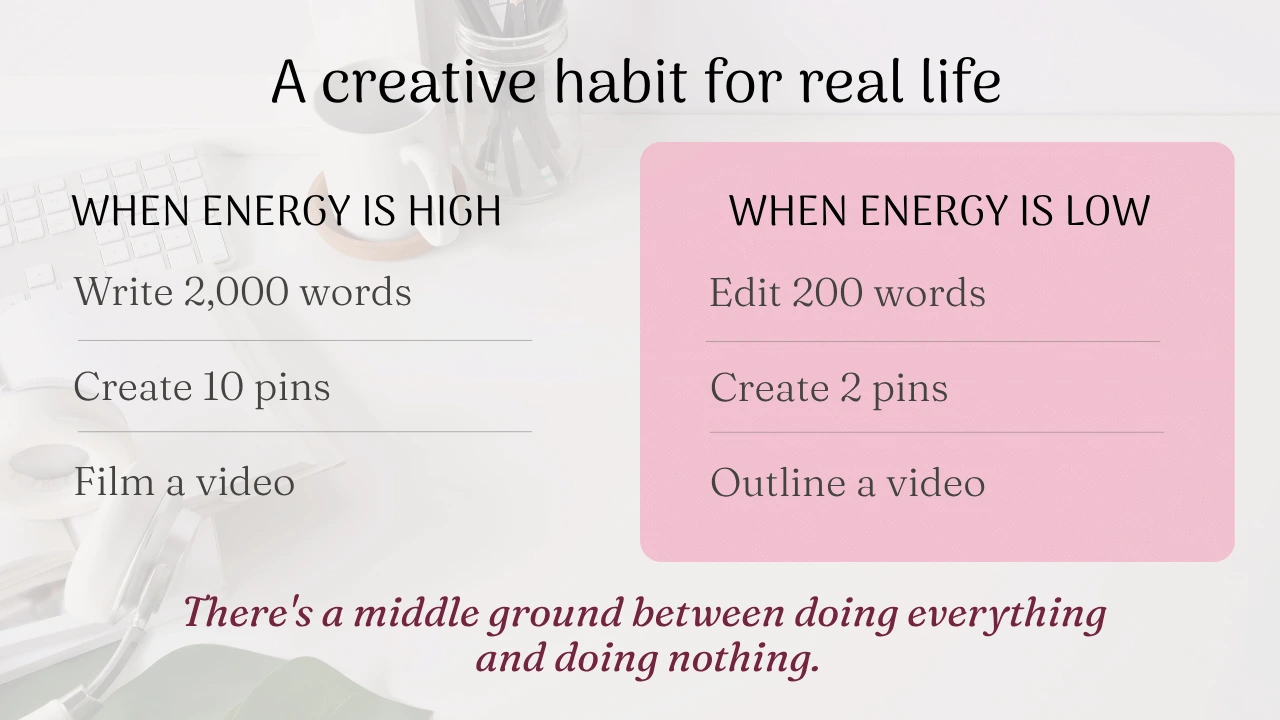
Decide ahead of time what the bare minimum version of your habit looks like on the days you’ve got nothing left to give.
A few examples:
- Writing: edit 200 words instead of drafting 2,000
- YouTube: outline a video instead of filming one
- Social media: repurpose an existing idea instead of creating something new
- Newsletter: write three honest paragraphs instead of a full essay
- Pinterest: make two pins instead of ten
The choice isn’t between full productivity and doing nothing at all. There’s a whole middle ground most people never give themselves permission to use.
And that middle ground is often what keeps a habit alive through a rough month instead of dying out entirely.
The mastery of your light lives in the mastery of your shadows
8. Keep a “20 ways” list for your main creative goal
This is probably the least obvious habit on this list, and it might be the most useful one.
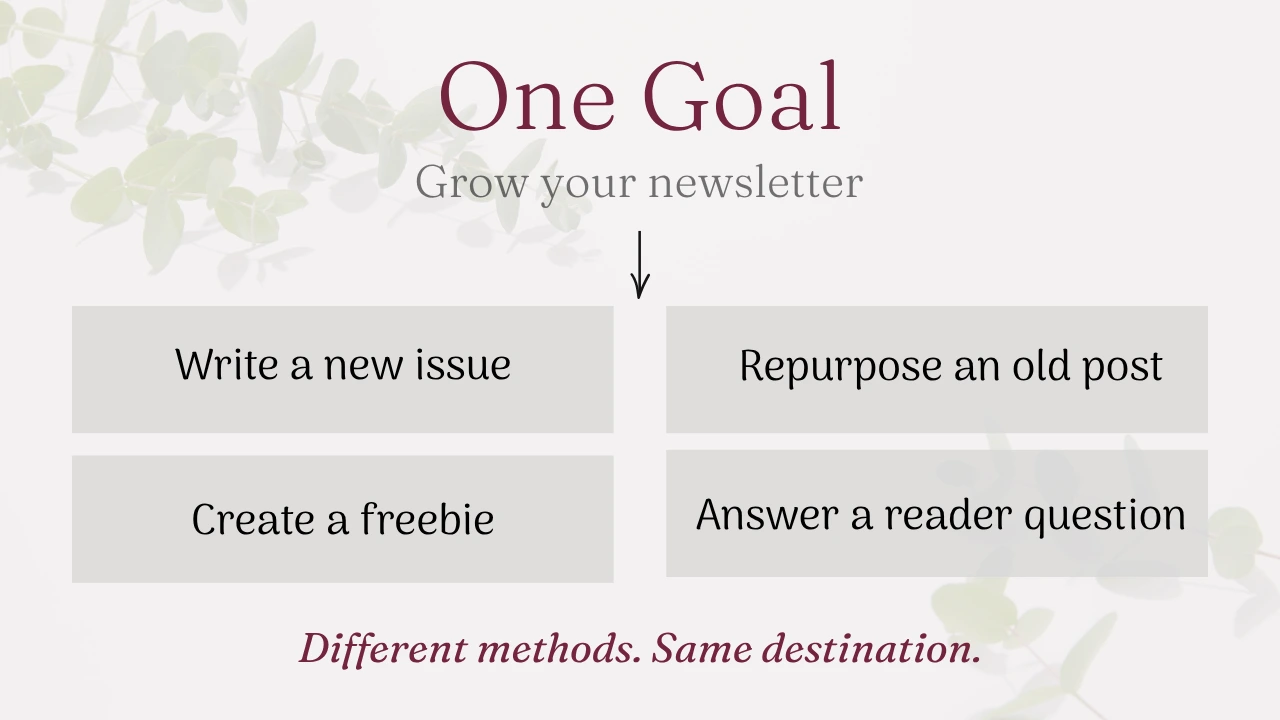
The idea is to pick a goal that matters to you and brainstorm 20 different ways you could make progress toward it. Say your goal is growing your newsletter.
Your list might include things like:
- write a newsletter issue
- repurpose an old article
- create a freebie
- write a short Note
- interview another creator
- improve your welcome email
- design a Pinterest pin
- update an old post
- answer a reader question publicly
- start a short content series
If your preferred method becomes impossible one week, you’re not stuck concluding “I guess I can’t be consistent right now.” You just pick a different path toward the same destination.
Consistency in your identity as a creator doesn’t actually require consistency in your method.
That distinction alone can save a habit that would otherwise collapse the first time your usual approach stops working.
9. Use the fun filter
When you’ve got a few different ways to create something, ask yourself which one actually sounds enjoyable right now, not which one a hyper-productive person would pick.
Say you need to create something today and you’re choosing between a 2,000-word article, a quick video, or a carousel.
If the carousel is the one that sounds fun, make the carousel. Enjoyment isn’t a luxury tacked onto consistency; it’s part of what makes repetition sustainable in the first place.
A habit that constantly requires you to override your own preferences is a habit you’re eventually going to abandon.
10. Have a “get back on track” rule
Even before it happens, decide what you’ll do the next time you fall off. Some options:
- never miss twice in a row
- after a missed week, restart with one small piece of content
- during chaotic stretches, switch to your low-energy routine until things settle
Missing a day isn’t the opposite of consistency. Not coming back is.
The goal was never to become someone who stays perfectly in rhythm forever. It’s to become someone who knows how to find their way back when life inevitably knocks them off course.
Build a creative rhythm you can actually live with
You don’t need to post every day, follow a rigid routine, batch thirty pieces of content every weekend, run on constant motivation, work at maximum energy all the time, or create the exact same way every single time.
What actually moves the needle is smaller than that:
- capture your ideas,
- choose tomorrow’s first task the night before,
- protect a recurring creative slot, cut the friction out of starting,
- lean on templates, batch when it genuinely helps,
- build a low-energy version of your habit,
- keep more than one path toward your goal,
- pick the option that sounds fun,
- and have a plan for getting back on track.
Rigid consistency says you have to do things the same way every time.
But sustainable consistency says something a lot more forgiving because you just have to know how to keep moving, even when everything around you changes.
If this kind of low-pressure, systems-first approach to creating resonates, it’s basically the whole philosophy behind the Desk & Digital newsletter.
It’s where I dig deeper into this stuff, tools, workflows, the occasional reality check, so if that sounds like your thing, there’s a spot to sign up right here.