When you have only a few hours, you need a system to help you manage the time you have.
A few years back, I convinced myself I couldn’t start anything meaningful until I had a free weekend to dedicate to it. That weekend never came.
What did come was 5 hours here and there between client work, and eventually I realized those scraps of time were the business, not the warm-up act before the “real” work began.
If you’re stuck in a similar spot, juggling a job, a family, or just a life that doesn’t leave room for a 40-hour side hustle, I want to tell you something that might sound counterintuitive:
5 focused hours a week is genuinely enough to build something that lasts.
All you really need is a smart way of using the time you already have.
This post walks through exactly how to structure those 5 hours, what deserves your attention, what you should stop doing entirely, and how to keep growing without running yourself into the ground.
Stop measuring your business in hours logged
Most of us were trained to think success looks like effort, and we count it as long days, full calendars, the pride that comes with having a busy day.
But this mindset works against you when your time is genuinely limited because when it comes to building a business, all that really matters is result.

Think about the 80/20 rule, I’m sure you’ve heard about it. But if you haven’t, it’s common knowledge in the productivity space that roughly 20% of what you do produces 80% of your results.
This means that a huge chunk of the activities we do is usually just noise and distractions, like tweaking your website font for the third time, reorganizing your Notion workspace, or scrolling “for research.”
And if you only have 5 hours a week to build your business, you can’t afford noise. You need to know, with some honesty, which tasks are actually moving the needle and which ones just feel like progress.
You can use this free 5-Hour Business Planner to plan your 5 hours in advance to make sure you only focus on the 20% of tasks that actually help to move your business forward.
Shift from a presence mindset to a production mindset.
It’s easy to spend hours on your work desk organizing files and rearranging your schedule, then get sidelined by a notification, then come back to clean up your inbox.
And after 5 hours, you feel like you’ve been busy all day, but what did you actually achieve? That’s the real question. And most times, the answer isn’t very clear.
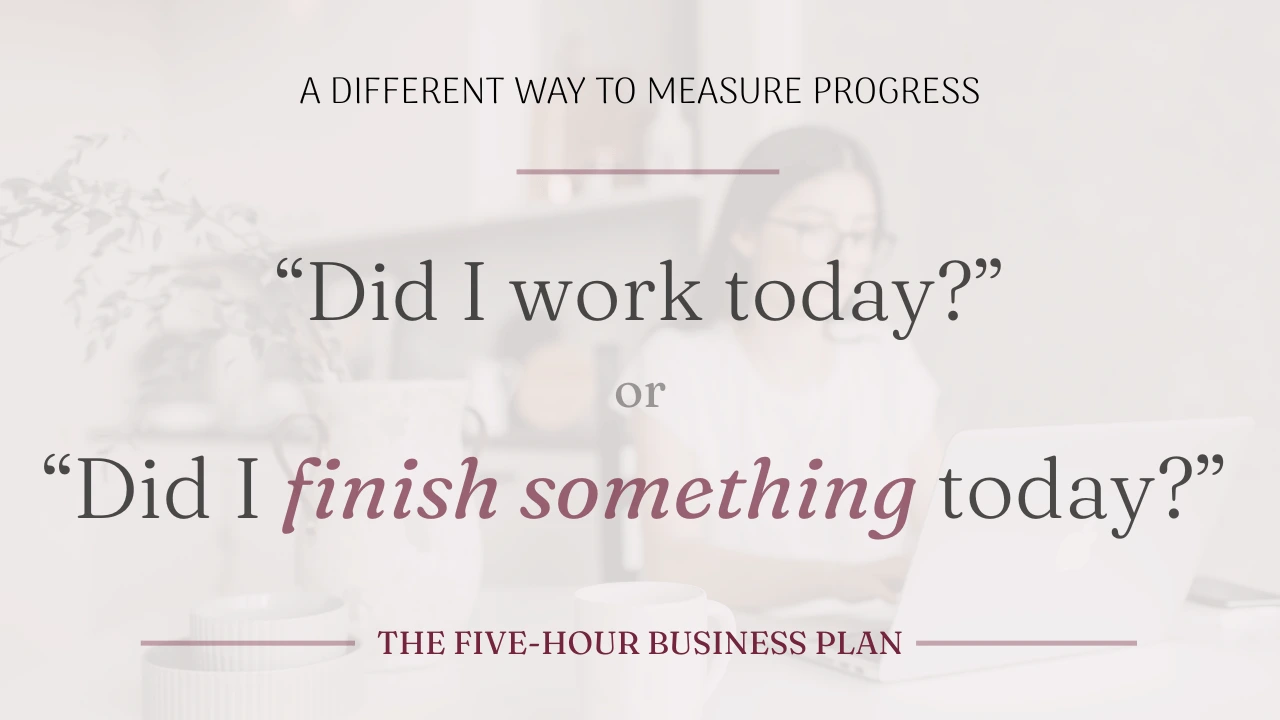
So instead of asking “did I work today,” focus on “did I finish something today.”
And this isn’t about hustling harder in a shorter window.
It’s about giving yourself real boundaries, because tasks tend to expand to fill whatever time you hand them (you’ve probably felt this, like when a 20-minute task somehow eats your whole afternoon when there’s no deadline pressing on it).
Accept that you can’t do everything, and let that be freeing rather than defeating.
As a solopreneur building a side hustle, you need to come to terms with the fact that you really can’t handle everything yourself, no matter how great you are at multitasking. Because trying to do it all by yourself is exactly how burnout happens.
Building a business means learning to manage yourself and pace yourself so you don’t quickly burn through your energy and motivation. Because trust me, the only way to be successful is to stay consistent.
If you want your business to still be up and running 6 months from now, 1 year from now, 3 years from now, then you absolutely need to learn to manage yourself, and if that means asking for help when you need it, or taking a break from work, then do that.
How to actually divide your 5 hours
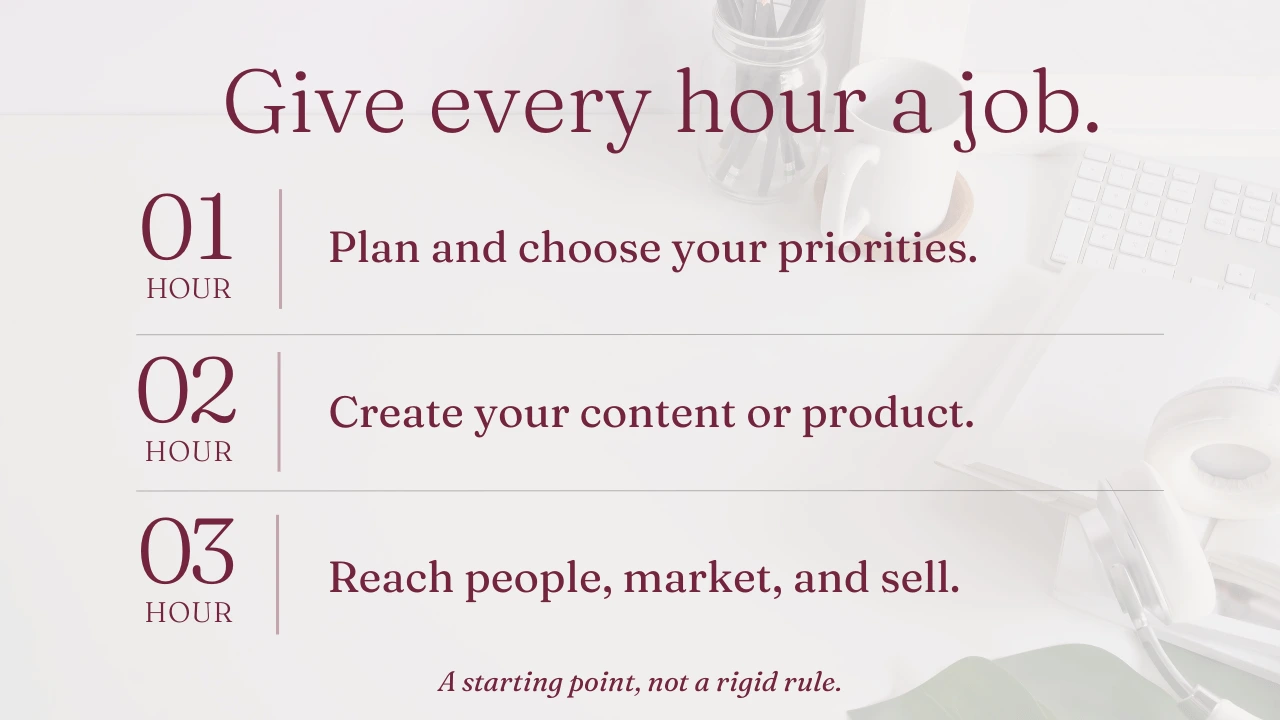
Structure removes the guesswork, and guesswork is what eats time you don’t have to spare. Here’s a simple way to carve up your week:
| Time Block | Focus Area |
|---|---|
| 1 hour | Strategy and planning |
| 2 hours | Core content or product creation |
| 2 hours | Outreach, sales, or community engagement |
You can adjust the ratios depending on what stage you’re at (early on, you might lean harder into product creation, but once you have something to sell, outreach deserves more of the pie).
What matters is that each hour has a job, so you’re not opening your laptop and wondering where to start.
Within that structure, 4 categories tend to cover everything a solo business actually needs:
- Skill and strategy development: learning the specific, high-value skills your business depends on, not every skill that looks interesting.
- Asset building: creating things that keep working after you’ve stopped actively working, like templates, digital products, or evergreen content.
- Discoverability and marketing: showing up on platforms with compound reach (think search or email, where your work keeps finding people long after you hit publish) instead of platforms that demand constant feeding.
- Business operations and admin: the unglamorous but necessary stuff, handled in a contained block instead of leaking into every other part of your day.
Before you even open a laptop, it’s worth doing a bit of mindset prep.
Get honest about your doubts and fears so they’re not quietly running the show, and figure out which personal qualities (discipline, organization, whatever’s shaky for you) you need to build outside your business hours, so they’re not eating into the five you’ve set aside.
If you want a tool that turns all of this into something you can actually fill out and follow, grab the free 5-Hour Business Planner.
From there, get specific about who you’re serving.
Deep clarity about your ideal client makes every other decision faster because you find out what to create, how to market it, what to say no to.
And once you know your audience, spend the bulk of your time on income-producing activities, and sales, marketing, and direct revenue work should take up about 80% of your hours, with the remaining 20% going toward skill building.
It’s tempting to flip that ratio when you’re just starting out and everything feels unfamiliar, but constant learning without enough doing is its own kind of procrastination.
Manage your energy like it’s a budget
This is the part most productivity advice skips entirely, and it’s probably the most important piece.
When you only have 5 hours a week, energy matters just as much as the hours themselves.
Trying to write copy or plan a launch when you’re very tired after a long workday is a losing battle, no matter how disciplined you are.
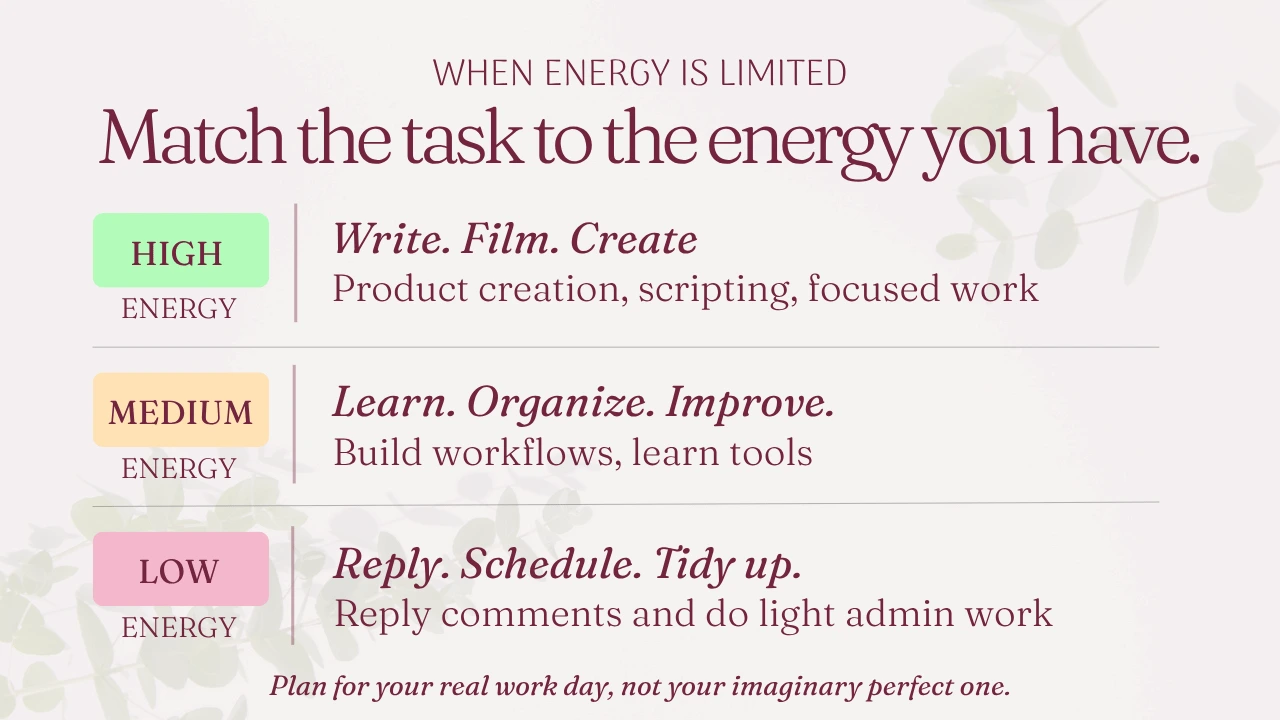
So, here’s what I like to do: I group all the important tasks according to how energy-intensive they are.
Low-energy tasks like replying to social media comments or replying to emails are reserved for when I’m low on energy.
And high-energy tasks like designing new Canva templates, building a new webpage, or creating content are for when I’m actually fully alert and ready for a few hours of deep work.
And I suggest you do the same too. Rate your tasks by how much mental energy they actually require:
| Zone | Rating | Energy level | Examples |
|---|---|---|---|
| Green | 4–5 | High | Content & product creation |
| Yellow | 2.5–3.9 | Medium | Building workflows, learning new tools |
| Red | 1–2 | Low | Replying to comments |
Once you know which energy level a task falls into, match it to your actual energy that day instead of your ideal energy.
Save high-energy work for when your focus is sharpest, whether that’s early morning before the world wakes up or a lunch break where your brain hasn’t hit its afternoon slump yet.
Push the low-energy stuff, the low-stakes tasks, to whenever you’re running on fumes after work.
One trick that’s genuinely changed how I work is the energy sandwich.
And this method is simple, you alternate a heavy cognitive task with something physical or low-effort, like a short walk, a shower, or a few minutes doing nothing in particular.
I find that doing this helps to reset my brain in a way that just powering through never does, and it means you can actually sustain focus across your 5 hours instead of burning out by the second hour.
Start narrow: one problem, one offer
A lot of people stall out before they even begin because they’re trying to solve too many problems for too many people. When your time is limited, vague is expensive. And there are a few ways you can avoid this.
Pick one specific problem with a clear outcome.
“Resume optimization” beats “career coaching.” “Instagram templates for coquette-aesthetic small businesses” beats “social media design services.”
The narrower your promise, the faster people understand what you do and the faster you can build the thing that delivers it.
Test before you build.
It’s tempting to spend weeks perfecting a product or a full website before anyone’s even confirmed they want it.
But you don’t need to do all that. I’m telling you now to resist this temptation no matter how strong it is.
Instead, pitch a simple offer directly to a small group and see what happens.
This way, you can very easily validate real interest in just a few hours of outreach, which is a much better use of your limited time than building in a vacuum.
Skip the full website for now.
Instead of building out a full website while you’re probably still figuring things out, go for a single-page offer document, laying out who your offer is for, what results they can expect, and the price.
You can always build the polished site later, once you know the offer actually has an audience who are ready for it.
Build toward one signature offer.
If you’re like me, you might be tempted to juggle 5 different products or services, but again, this is a bad idea.
Put your limited time and energy into one high-value, transformational offer that you can charge properly for.
It simplifies your marketing, and it means fewer clients or sales can still add up to real income.
Books to read before you launch your first digital product
Build systems so you’re not reinventing the wheel every week
Decision fatigue is sneaky, and it’s not just big decisions that drain you, it’s the small ones, like “what should this email say” or “how do I format this post,” repeated over and over until your 5 hours are gone before you’ve made real progress.
So, how do you avoid this? The simplest way is to plan your 5 hours in advance, so you waste even a second when you sit down to work.
This 5-Hour Business Planner can help you with that, grab your own copy, it’s free!

Another great way to make sure you’re not wasting precious time is to create templates and simple procedures for anything you’ll do more than once.
I like to have handy templates for almost everything I do repeatedly, and I don’t only mean design templates and an AI prompt library (although those are very important), I also mean simple step-by-step guides I create for myself to make my work easier.
Because I find out that if I have a detailed guide on how to complete a certain task, it’s often easier to follow the steps and get the work done while listening to my favorite work playlist.
This can be really helpful so that when you sit down for a focused hour, you want zero decision-making standing between you and the actual work.
Pick one platform and actually commit to it
It’s always best to choose one social platform and one long-form medium, then go deep instead of wide.
Because spreading yourself across 5 platforms means doing all of them halfway, which tends to produce worse results than doing one platform well. Pick the place your audience already spends time, and let the rest go for now.
Favor platforms with compound reach.
I find that search-based platforms (anything that can show up on Google search) and email lists keep working long after you hit publish, which matters enormously when your time is scarce.
A well-optimized blog post or Pinterest pin can bring in traffic 6 months from now with zero additional effort from you, but a tweet’s lifespan is measured in hours.
Protect your hours from constant interruption.
You definitely should turn off real-time notifications because this will only lead to distractions.
And if you must check your email or DM, then do so in a short, defined window instead of letting it trickle into every part of your day.
This one’s simple in theory and genuinely hard in practice, but it makes a real difference in how much you can get done in a limited window.
Delegate the moment you can afford to
As revenue starts coming in, resist the urge to hold onto everything yourself just because you can technically do it.
Outsourcing the low-leverage tasks, the admin, the scheduling, the parts of the business that don’t require your specific voice or judgment, frees up your hours for the work only you can do.
This doesn’t need to happen all at once, and it doesn’t need to be expensive. Even a few hours of outsourced help a month can shift you from doing everything to acting more like the person steering the business.
All you really need is a plan for the time you have
If there’s one thing I want you to walk away with, it’s that the 5 hours you have aren’t the obstacle. The absence of a plan for those 5 hours is the obstacle.
Once you know what to focus on, how to manage your energy, and which systems to build early, five hours a week is more than enough to create something real.
Start small. Pick one idea from this post, whether it’s the energy zones, the narrow offer, or just protecting your focus time from notifications, and try it this week. You don’t need to overhaul everything at once.
If you want a head start, the free 5-Hour Business Planner walks you through this entire framework in a fill-in-the-blank format, so you’re not just reading about a plan, you’re actually building one.
And if you liked this kind of breakdown, that’s basically what I do over at the Desk & Digital newsletter: practical, no-fluff strategies for building a creative business without needing more hours in the day than you actually have.
Come hang out if that sounds like your thing.